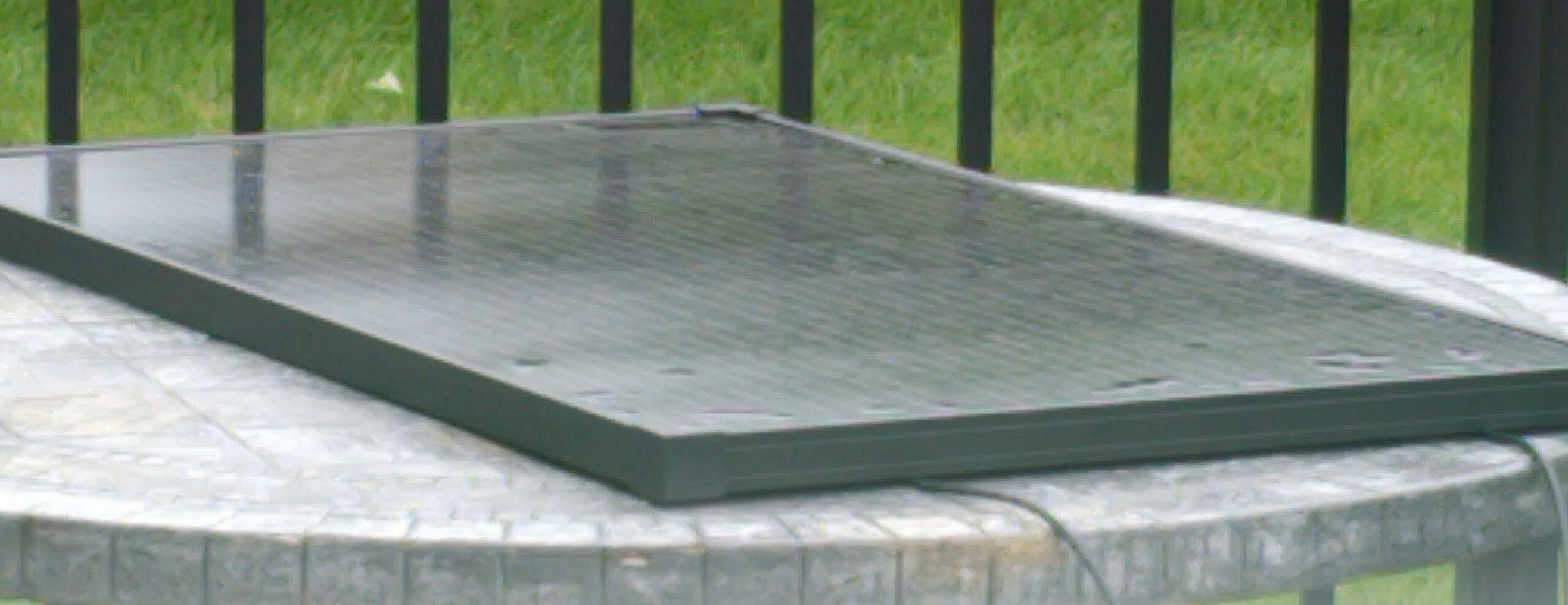
Note: This is an unaffiliated, honest review. I have no relationship with EcoFlow. I spent my own money on this panel.
To save you some time, here is the quick, no-BS verdict on the EcoFlow 100W Rigid Solar Panel (Model ZMS331-1): it is a surprisingly tough, no-nonsense piece of gear. It won’t degrade in three summers like cheap flexible panels, the anodized aluminum frame is rock-solid, and under full, direct sunlight, it delivers honest power. But if even a tiny spot of dirt, paint, or shade covers a single cell, total power output plummets by 30%, and EcoFlow opted for not bundling the essential adapter cable or including a basic kickstand in the box.
| The Good | The Annoying |
| ✓ Tough as nails; IP68 aluminum/glass frame takes serious abuse | ✗ Requires buying a separate $20 MC4-to-XT60 cable for EcoFlow stations |
| ✓ Standard MC4 connectors prevent proprietary brand lock-in | ✗ Partial shading (like a tiny paint spot) drops output by 30% |
| ✓ Pre-drilled frame slots make vehicle roof mounting effortless | ✗ No built-in kickstand for ground or portable setups |
| ✓ Delivers honest 100W output under full, direct sun | ✗ Larger physical footprint due to older ~21% PERC cell tech |
If you want an honest look at this panel without the usual sponsored affiliate fluff, here is my experience after beating it up off-grid.
Why I Bought It (And What It Actually Does)
I didn’t buy this panel to set up a massive off-grid solar farm on a cabin roof. I bought it for practical off-grid field use: running as an unmounted ground panel at temporary campsites and keeping my portable power station topped off.
Everyone on YouTube talks about slick folding canvas solar panels. But rigid glass-and-aluminum panels are what you actually buy if you want something that won’t flex until the solar cells micro-crack inside or degrade under continuous heat exposure.
At 13.7 lbs and under 40 inches long, it’s manageable enough to toss in the trunk(some, in my case had to sit in the backseat), lean against a bumper, or bolt onto a roof rack without worrying about weather damage.
Kudos to the Engineering Team (It Actually Lasts)
Before getting into the electrical nuances, I want to give credit where credit is due: the structural build quality on this panel is phenomenal.
In an era where so much outdoor gear feels flimsy and engineered to break after one season, EcoFlow built a tank here. The anodized aluminum frame doesn’t twist when you lift it, and the tempered glass front can handle impacts, road gravel, and high winds that would completely destroy flexible ETFE panels. You can throw this in the back of your rig, leave it out in pouring rain, or spray it down with a hose thanks to the IP68 waterproof junction box. Sincere kudos to the hardware design team on that front.
Specs That Matter (Cut Through the Fine Print)
Let’s look at what this panel actually delivers under Standard Test Conditions (STC: 1000 W/m², 25°C):
| Specification Parameter | Raw Value / Rating | Blunt Reality & Technical Context |
| Rated Power Output | 100 W (+/- 5W) | Peak output under perfect laboratory conditions and perfectly clean glass (a small amount of pain on the glass in my case has this capped at 70W) |
| Cell Technology | Monocrystalline PERC | Older-gen single-crystal cells; reliable but bulkier per watt |
| Open Circuit Voltage (Voc) | 20.3 V | Voltage output with zero electrical load connected |
| Short Circuit Current (Isc) | 6.3 A | Maximum shorted amperage output |
| Max Operating Voltage (Vmp) | 17.1 V | Sweet spot target voltage for MPPT charge controllers |
| Max Operating Current (Imp) | 5.9 A | Max amperage delivery at peak load |
| Physical Dimensions | 38.6 x 23.1 x 1.18 in (980 x 586 x 30 mm) | Noticeably larger footprint compared to newer TOPCon panels |
| Weight | 13.7 lbs (6.2 kg) | Heavy aluminum frame; solid, but you’ll feel it if hauling by hand |
| Weather / Ingress Rating | IP68 Waterproof | Fully sealed junction box; handles rain, mud, and power washes |
| Output Terminals | Standard MC4 Connectors | Universal locking pigtails; no proprietary connector locks |
| Temperature Coefficient | -0.39% / °C | Output drops by ~0.4W for every degree over 25°C cell temp |
The Partial Shading Reality Check: How a Tiny Paint Spot Kills 30% of Your Power
Here is something most casual reviewers completely miss: this panel requires 100% direct, unshaded sunlight across its entire glass face, or your power harvest crashes hard.
On my specific unit, a tiny dot of paint got onto the glass surface—covering just a fraction of a single solar cell. Under blazing, direct midday sun, guess what the maximum charge rate was? ~70W max. A tiny spot of paint hard-capped a 100W panel at 70% capacity.
The Engineering Explanation: Series Strings & Bypass Diodes
Why does shading 1% of a solar panel kill 30% of your total power?
- Series Cell Bottlenecks: A 100W monocrystalline panel consists of individual cells wired together in series. In a series electrical circuit, current is choked down by the single weakest link. If one cell goes dark (or gets covered in paint, bird droppings, or tree shade), its internal resistance spikes and chokes current across the whole string.
- Bypass Diodes to the Rescue (Sort Of): To prevent that shaded cell from overheating and melting the internal lamination (hotspotting), the junction box contains bypass diodes. On this 36-cell panel, the cells are split into 3 sub-strings of 12 cells each.
- The 30W Power Drop: When the paint spot blocks light to one cell, the voltage across that sub-string drops negative, forward-biasing the bypass diode. The diode successfully routes current around those 12 cells so the panel doesn’t burn itself out. But in doing so, you instantly lose one-third of your operating voltage ($V_{mp}$ drops from 17.1V to ~11.4V).
The remaining 24 cells are working perfectly, but because 1 sub-string is bypassed, your 100W panel is hard-capped at ~67–70W.
Blunt Field Advice: If you’re setting this up near shade trees, roof racks with gear shadows, or dirty off-grid campsites, keep the glass clean and completely out of the shade. Otherwise, you’re paying for 100W and receiving 70W. If you can go for a bifacial panel that can capture residual light as well.
The Cable Friction (And An Honest Defense)
If you buy this panel expecting to unbox it and plug it straight into an EcoFlow River or Delta power station, you’re in for an annoying surprise: it won’t connect out of the box.
- The Annoyance: You have to buy a separate MC4-to-XT60 (or XT60i) solar charging cable (typically an extra $15–$25 for the 3.5m length). For an ecosystem brand selling both the power station and the panel, not bundling an adapter cable feels cheap.
- The Honest Defense: Bluntly, while it’s an inconvenient extra purchase, using industry-standard MC4 pigtails on the panel itself is the right engineering decision. It prevents proprietary lock-in. You can plug this 100W panel into Anker, Jackery, Bluetti, or Goal Zero power stations with cheap standard adapters, or wire it into existing RV solar charge controllers with off-the-shelf MC4 Y-splitters.
Size & Efficiency: Older PERC vs. Modern TOPCon Panels
Let’s address panel generation and physical footprint: this unit uses older technology, making it bulkier and less efficient than the newest panels hitting the market.
- Footprint: At 38.6 x 23.1 inches, it takes up considerable surface area for a 100W yield.
- The Efficiency Gap: It relies on older monocrystalline PERC technology, topping out around 21%–22% cell efficiency.
- Modern Alternatives: Newer N-type TOPCon panels push 23%–25%+ conversion efficiency. That means modern 100W panels can be made noticeably smaller or deliver 115W–120W in this exact same frame footprint.
It’s definitely not obsolete—the heavy glass and thick aluminum frame mean it will outlast flimsy flexible panels—but if mounting space on a tight car roof rack is at a premium, know that you’re sacrificing square footage for older, cheaper cell tech.
Off-Grid Field Use & Mounting Points
In terms of actual field installation, EcoFlow nailed the pre-drilled mounting slots along the back of the aluminum frame.
- You don’t have to drill into the extrusion yourself or ruin the protective weather coating.
- The pre-cut slots line up easily with standard Z-brackets, roof rack crossbars, U-bolts, or heavy-duty carabiners and bungees for quick temporary tie-downs on vehicle roofs.
The Annoying Quirks: Where Is the Built-In Kickstand?
Here is my single biggest pet peeve when using this panel in a portable, unmounted setup: it has zero built-in support.
When using this as a ground panel, you end up leaning it against car tires, cooler boxes, or camp chairs. Inevitably, the wind knocks it over or it slides flat onto the ground, destroying your sun angle and tanking solar harvest.
While rigid panels are technically designed for permanent roof mounting, tons of people buy them for portable ground setups because they’re cheaper and tougher than canvas folding panels. EcoFlow should sell or bundle a simple snap-on or folding tilt-leg mechanism. Having to lean a $100+ glass panel against a muddy tire is stupid.
A Note on Newer Versions
Keep in mind that this PERC-based 100W rigid panel is a mature design. EcoFlow and other manufacturers are starting to transition their product lines to newer N-type TOPCon cell technology. If you are shopping around, keep an eye out for newer revisions that might offer smaller physical dimensions or higher efficiency for similar money. If you’ve picked up one of EcoFlow’s newer panel revisions, leave a comment and let me know how the efficiency and sizing compare.
The Verdict
So, is the EcoFlow 100W Rigid Solar Panel worth it?
If you want a durable, weather-resistant solar panel for a vehicle roof rack, RV, or rugged campsite setup that will survive years of physical abuse, yes—it’s a great buy. It delivers honest power in full sun, uses standard MC4 connectors, and won’t fall apart.
Just make sure to buy the MC4-to-XT60 cable beforehand, keep the glass entirely out of the shade, and figure out a tilt setup so you aren’t leaning it against your truck tire.
Hey, if anyone from EcoFlow, Bluetti, Jackery, or literally any other brand is reading this and wants me to review their latest gear, feel free to reach out via the comments.
Legal & Operational Disclaimers
- Brand & Copyright Notice: EcoFlow, Bluetti, Jackery, and Goal Zero own their respective copyrights and trademarks. All product names, logos, and brand imagery used in this review are property of their respective owners and are used strictly for identification, educational, and critical commentary purposes under the Fair Use doctrine of copyright law.
- Non-Sponsorship Disclosure: This post is completely independent and unsponsored. I purchased the EcoFlow 100W Rigid Solar Panel directly with my own funds. EcoFlow did not sponsor this content, provide free merchandise, or review this material prior to publication.
- Technical & Safety Disclaimer: Solar power installations and electrical modifications carry inherent safety risks including electrical shock and thermal hazards. This review is for informational, educational, and entertainment purposes only. Individual results may vary. Always consult official product documentation, local building/electrical codes, and qualified professionals before installing or wiring electrical equipment. The author assumes no liability for damages or injuries resulting from the use of this information or hardware.
Leave a Reply