Generative AI—specifically Large Language Models (LLMs)—has evolved rapidly in a very short time. What started as simple “autocorrect on steroids” or stochastic parrot has transformed into a reasoning engine capable of driving complex business operations.
For business leaders, the question is no longer “What is AI?” but “How can I apply it to stop wasting time and start making money?”
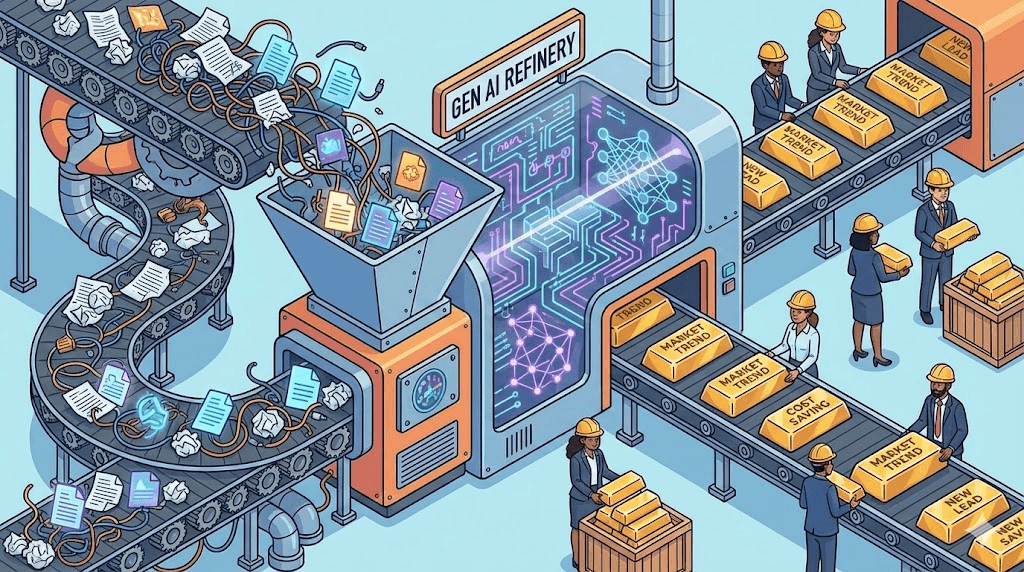
The Evolution: From “Completions” to “Reasoning”
Initially, LLMs were designed for “completions.” They were essentially probability machines, predicting the next likely word in a sentence or line of code. This was a neat party trick, but limited in utility unless you already had a strong starting point.
The first glimpse of real ROI came with tools like GitHub Copilot. Suddenly, developers weren’t just getting syntax suggestions; they were getting entire logic blocks completed for them. It was the first major case of genuine utility.
The Turning Point: Instruction Tuning
Everything changed with the advent of instruction-tuned models (like the technology powering early ChatGPT and GPT-4). Instead of just predicting text, these models were trained on human feedback to understand intent. They learned to answer questions, follow complex instructions, and adapt to different personas.
Suddenly, the utility exploded. You could draft emails, summarize legal briefs, or restructure data formats. However, early adoption was often limited to novelty use cases, and the models were prone to “hallucinations”—confidently making things up.
The Modern Era: Reasoning and Agents
Today, thanks to innovations in attention mechanisms, context engineering, and “train-time compute” (giving models time to “think” before answering), we have arrived at a new tier of intelligence. Models like Claude 4 Sonnet, Gemini 3 Pro, and GPT-5 are far less prone to errors and capable of acting as agents—software that doesn’t just write text, but executes tasks.
Real-World Applications: Where is the Money Being Spent?
Billions have been invested in this infrastructure. Here is how that investment is translating into operational efficiency across industries right now.
1. Sales and Marketing
- Lead Scoring & Qualification: AI agents can analyze incoming leads against your ideal customer profile (ICP) instantly.
- Hyper-Personalized Outreach: Sending thousands of emails that read as if they were written one-by-one.
- Dynamic Copywriting: Generating ad variations and blog posts (like this one) in seconds.
- Churn Prediction: Analyzing customer behavior patterns to flag at-risk accounts before they leave.
2. Customer Support & Success
- RAG-Enabled Support: Chatbots that actually work, using Retrieval-Augmented Generation (RAG) to pull answers specifically from your internal company documentation, not the open internet.
- Ticket Triage: Automatically tagging and routing support tickets to the correct department.
- Sentiment Analysis: Monitoring calls and chats to gauge customer satisfaction in real-time.
3. Operations & Administration
- Inbox Management: AI assistants that draft replies and sort priority emails.
- Smart Scheduling: Agents that negotiate calendar times between multiple parties without you lifting a finger.
- Document Digitization: Extracting structured data (names, dates, dollar amounts) from PDFs and handwritten forms.
4. Software Engineering
- Autonomous Coding Agents: Tools that can scaffold entire applications or refactor legacy codebases. Some can create entire prototype applications in minutes.
- Bug Hunting: AI that scans code for vulnerabilities and suggests fixes before deployment.
- Documentation: Automatically updating technical docs as the code changes.
5. Blue Collar & Field Services (HVAC, Plumbing, Construction)
This is one of the fastest-growing sectors for AI adoption.
- Automated Quoting: Customers upload a photo of a broken pipe or electrical panel; AI analyzes the image and hardware requirements to draft an initial quote.
- Dispatch Optimization: Algorithms that route technicians based on location, traffic, and job expertise.
- Voice Receptionists: AI agents handling after-hours calls, booking appointments, and answering FAQs while your crew is out working.
- See Build-Folio
6. Healthcare & Legal
- Clinical Scribe: Listening to doctor-patient interactions and automatically updating Electronic Health Records (EHR). Saving time/cost for all parties involved.
- Diagnosis Support: Analyzing patient history and symptoms to suggest potential diagnoses for physician review.
- Gene and Protein Research: Generative AI is also being used to create new proteins for gene therapy that can be printed and used in real life saving years of computing power from previous protein folding experiments.
- Contract Review: identifying risky clauses in legal documents instantly.
- Case Law Research: Summarizing thousands of pages of relevant precedents in minutes.
7. Creative & Design
- Asset Generation: Creating royalty-free images and vector graphics for marketing materials. Video that is generated based on exactly what you want without a film crew or any of the heavy production costs.
- Video Editing: AI tools that cut silence, add captions, and color-grade footage automatically.
8. Human Resources
- Resume Screening: Parsing thousands of applications to find the best functional fit in a fraction of the time.
- Onboarding: AI agents that guide new hires through paperwork and training modules.
9. Manufacturing & Robotics
- Predictive Maintenance: AI analyzing sensor data to predict when a machine will fail before it happens.
- Humanoid Robotics: Companies like FigureAI have operationalized generative AI in humanoid robots, currently deployed on assembly lines at major manufacturers like BMW to handle complex physical tasks.
10. Vehicles
- Consumer Augmented Autonomous Driving: Tesla was the first to apply the transformer architecture to autonomous self driving and operationalize it in the real world. They were the first public consumer facing application of operationalized transformer architecture. Nvidia is now working on democratizing this tech with the rest of the automakers.
- Robotaxi Service: Waymo was the first to apply transformer architecture to make a fully driverless robotaxi service. Tesla is a close second. Cars that pick up and drop off people autonomously.
11. Military
- Autonomous Jets: Companies like Anduril are innovating in this space to create “agents” of the sky with autonomous drone pilots that augment the fighter pilot’s capabilities.
- Autonomous Submarines: Anduril is also innovating in this space with autonomous submarines that can run by themselves underwater performing reconnaissance and swarm operations.
Ready to Future-Proof Your Business?
The gap between companies using AI and those ignoring it is widening every day. Whether you need to automate your back office, streamline your sales process, or integrate intelligent agents into your workflow, the technology is reaching the plateau of productivity (Gartner’s Hype Cycle term).
Secure your competitive advantage.
[Fill out the form at the top of this page] to start the conversation. Let’s discuss how we can build a custom AI strategy that fits your specific business needs.
Leave a Reply